
'%3e%3crect%20width='512'%20height='512'%20fill='%23fff'/%3e%3crect%20width='133'%20height='512'%20fill='%23d80027'/%3e%3crect%20x='379'%20width='133'%20height='512'%20fill='%23d80027'/%3e%3cpath%20fill='%23d80027'%20d='m256%20154.2%2013.4%2025c1.5%202.7%204.3%202.5%207%201l9.7-5-7.2%2038.4c-1.5%207%203.4%207%205.8%204l17-19%202.8%209.7c.3%201.3%201.8%202.7%204%202.3l21.5-4.5-5.6%2020.4c-.5%201.8-.7%203.6%201.4%204.4l7.3%203.4-35.1%2028.5c-1.4%201-2%203-1.5%205.3l3%2010-33.3-2.8c-2.5%200-4.2%201.4-4.2%203.4l1.6%2037.4h-11l1.5-37.4c0-2-1.7-3.4-4.2-3.4l-33.3%202.8%203-10c.6-2.3%200-4.3-1.5-5.3l-35-28.5%207.2-3.4c2-.8%202-2.6%201.4-4.4l-5.6-20.4%2021.5%204.5c2.2.4%203.7-1%204-2.3l2.8-9.7%2017%2019c2.4%203%206.3%203%205.8-4l-7.2-38.4%209.7%205c2.7%201.5%205.5%201.7%207-1z'/%3e%3c/g%3e%3c/svg%3e)
'%3e%3crect%20width='24'%20height='8'%20fill='%23000'/%3e%3crect%20y='8'%20width='24'%20height='8'%20fill='%23DD0000'/%3e%3crect%20y='16'%20width='24'%20height='8'%20fill='%23FFCE00'/%3e%3c/g%3e%3c/svg%3e)
'%3e%3crect%20width='24'%20height='24'%20fill='%23006AA7'/%3e%3crect%20y='10'%20width='24'%20height='4'%20fill='%23FECC00'/%3e%3crect%20x='7'%20width='4'%20height='24'%20fill='%23FECC00'/%3e%3c/g%3e%3c/svg%3e)
Bunny and Clyde Slot — Free Demo & Review

Game information — Bunny and Clyde
Bunny and Clyde Slot Overview
Thirteen is an odd number of paylines to settle on. Most five-reel games round to ten, twenty or twenty-five; Poggi drew thirteen numbered patterns across a square five-by-five field and stopped there. Bunny and Clyde puts a rabbit in a red dress and a fox in a pinstripe suit outside a bank vault, hands them painted Easter eggs as wilds, and locks everything worth having behind a gold safe.
Four figures cover the maths. The RTP is 96.2%, the hard ceiling is 2,500x the stake, the bonus opens with three free spins, and it can be bought outright for 100x. Poggi shipped the slot on 27 March 2026 and writes the title "Bunny & Clyde" on its own pages — our spelling is the long one, the game is the same. The Bunny and Clyde demo above runs the studio's production build on play credits.
This Bunny and Clyde slot review takes the grid first, then the two symbols that never pay, then the bonus game where the reels stop showing normal symbols at all. Read that section if you read nothing else: the base game is scaffolding, deliberately so.
Theme and Design: An Easter Heist in Cartoon Noir
The art is Bonnie and Clyde retold with animals and holiday props. Cash stacks and gold bars pile up on the reels, police lights flash behind the frame. The Easter angle — painted eggs standing in for wilds — sounds like a seasonal gimmick and instead hands the slot a palette nobody else in the heist genre is using.
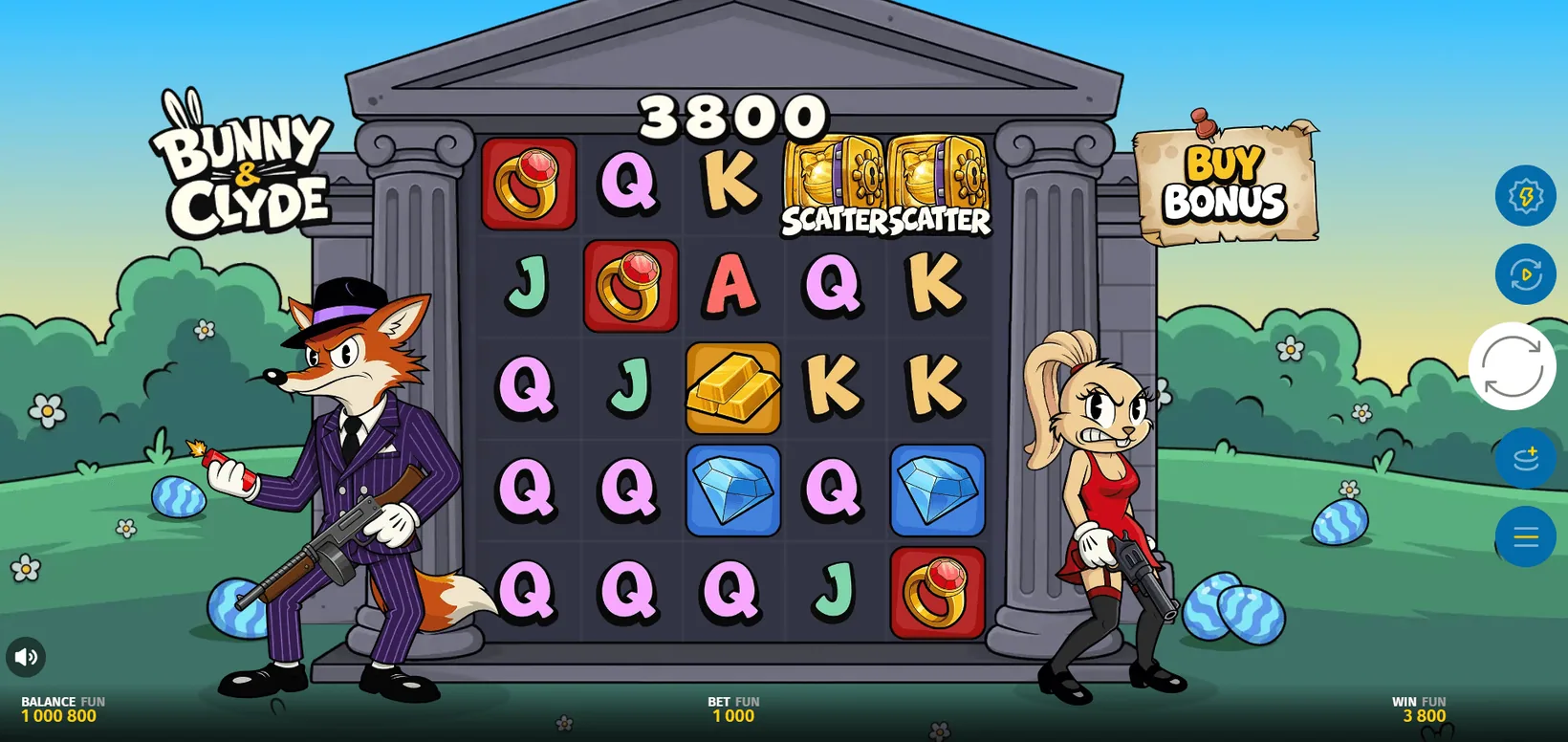
Nine symbols pay. Four are pictures — ruby ring, gold bars, diamond, cash stack — and under them the card ranks from ten up to the ace, which share one identical row of values instead of laddering down. Two further symbols carry no payout: the blue-and-silver egg and the gold vault safe. Everything interesting happens because of those two. Presentation stays quiet throughout: a paying pattern lights up, the counter ticks, the next spin loads without ceremony, and the whole board still reads cleanly on a phone.
How to Play Bunny and Clyde
A win needs at least three matching elements on one of the thirteen patterns, read inward from the left edge. The patterns are fixed, so nothing can be switched off, and each is drawn as a numbered diagram inside the rules, which is where the count of thirteen comes from. The gameplay asks for no decision beyond the size of your stake.
That stake ladder belongs to your casino, not the studio. Poggi publishes no cash range for this slot and its public demo pays in play credits, so the honest description is proportional: the floor sits at one twentieth of the default bet and the ceiling at a hundred times it, with the buy price and every payout moving with the rung you pick.
Fix that rung before you start rather than during. The bonus is settled against the bet that was live at the moment it opened, and the round can outlast a dozen spins. Your stake is not merely what a spin costs; inside the feature it is the coefficient the whole thing gets multiplied by.
Anyone about to play Bunny and Clyde slot with cash should know one more thing: the paytable is quoted against your total bet and never against a line bet. It was read at three widely different stakes in the live build, scaling in exact proportion at every one of them. Thirteen lines is precisely the count that tempts a reviewer into dividing. Do not.
Bunny and Clyde Bonus Features
The wild is the egg, and it has three habits worth memorising. It never lands on the leftmost or rightmost reel, so it works the middle three columns only. It substitutes for every paying symbol except the safe. And it never arrives bare — each one carries a multiplier of x2, x3 or x5.
Now the part reviews get wrong. When two or more eggs help the same winning pattern, their multipliers are added and the sum is applied once. Two x5 wilds make that line x10, not x25. Poggi's marketing says the wild multipliers "stack", which is true only in this additive sense, and the gap between adding and compounding is the gap between a good spin and a fantasy.
The safe is the scatter, and three or more of them, positioned anywhere, open the bonus game. That scatter appears in the main game only, which carries a consequence the rules never spell out: there is no retrigger. Once the feature is running no scatter can land on a spin, so the round has to sustain itself by other means — and the way it does that is the cleverest thing in the slot.
Inside the Bonus Game: Three Free Spins That Keep Coming Back
The board changes character completely. Regular symbols stop appearing, each of the five reels gets a multiplier counter above it starting at 1, and what drops from then on is either a booster or a broken jar worth nothing. Three free spins are on the clock, shown as three hearts beside the field.
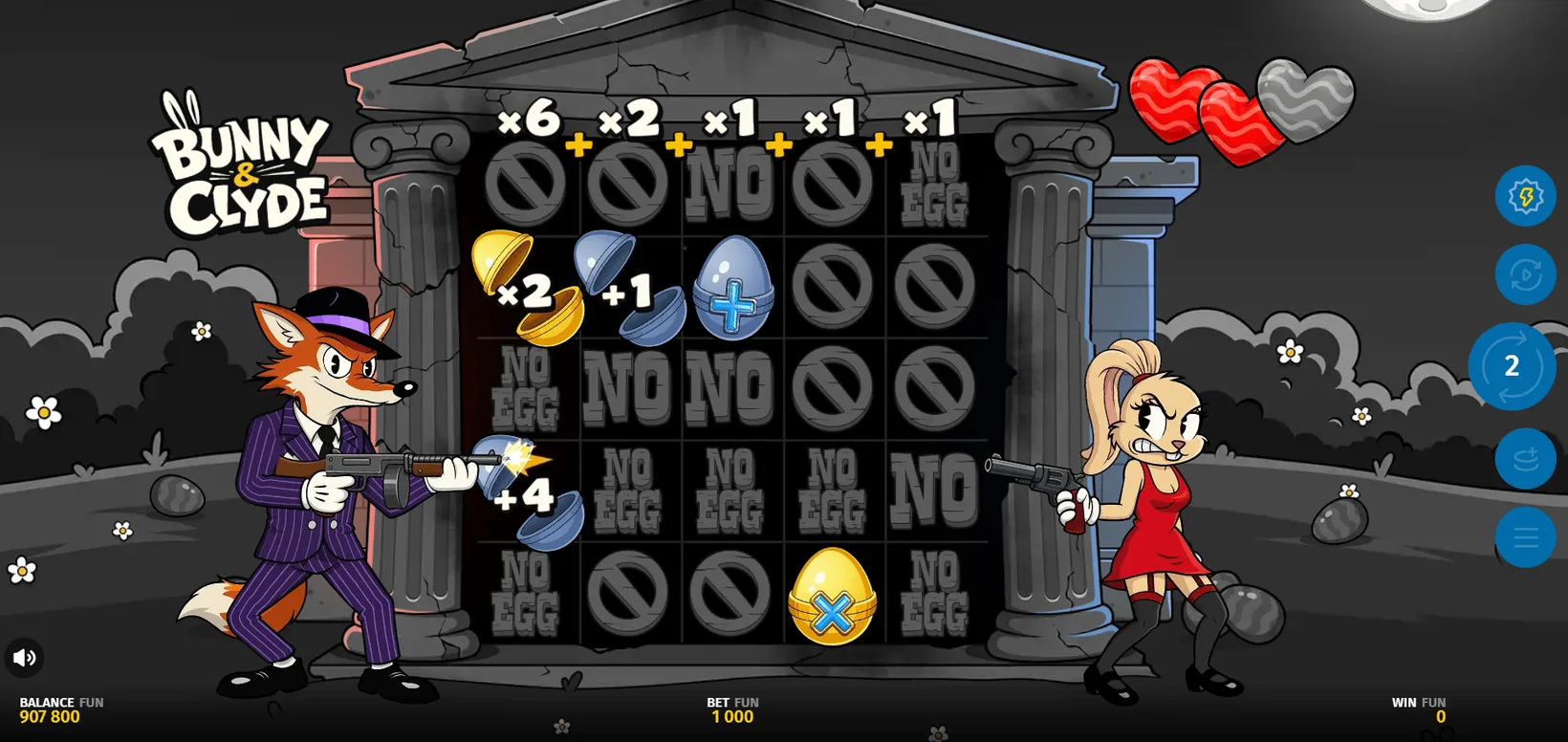
Here the studio contradicts itself, and the build wins. Poggi's promotional copy describes two kinds of booster, Silver and Golden, the silver ones adding and the golden ones multiplying. The rules screen inside the game lists four, on two axes: add 1 to 10 to the counter of the reel it landed on, add 1 to 10 to every reel at once, multiply its own reel's counter by 2 to 8, or multiply every reel by 2 to 8. The studio's own screenshots back the rules: one frame shows a silver +1, a second silver +4 and a golden x2 in the same round. Silver and gold are just the two visual families, each with a single-reel and an all-reels form. Four types, not two.
Every booster resets the free spins counter to three. Only a barren spin costs a heart. The round therefore lasts exactly as long as the board keeps giving, closing after three empty spins back to back or at the 2,500x ceiling. Then the five counters are summed, and that sum is multiplied by the bet from the start of the round. The studio's bonus screenshot shows x6, x2, x1, x1 and x1 above the reels: cash that board out and it settles at eleven times the stake. The all-reels boosters are what turn a board like that into a serious number.
If waiting for three safes does not appeal, the in-game menu sells the round for 100x. Read that price against the ceiling rather than against your hopes: 100x buys entry and nothing else, and three dead spins in a row empty the hearts just as fast as they were bought.
Bunny and Clyde RTP, Volatility and Max Win
The return is 96.2%. Two sources say so and neither borrows from the other: the catalogue field Poggi publishes and the rules screen of the live build, agreeing to the decimal. Call that fractionally generous by the standards of the format, and remember it is a long-run average measured across millions of spins, no guide at all to one evening.
The ceiling is 2,500x the bet, given as a maximum win multiplier in the rules and repeated in the bonus rules as the point where the round is cut off. Poggi's catalogue prints a second figure beside it, 250 000, and that one is a cash cap calculated at the largest permitted stake. It is not a multiplier and it belongs nowhere near a review.
One caveat this Bunny and Clyde review has to flag: Poggi never publishes a volatility word. What the studio publishes is a meter, and this one lights three bars of five, the middle of a scale its catalogue runs from two to five. "Medium" in our spec table is a reading of those bars, not a quote. The label undersells the shape, too. The base game trickles — the best picture symbol returns 30x, the card ranks five — while the distance to 2,500x is covered inside a feature you may wait a long time to trigger.
Bunny and Clyde Symbols and Paytable
The table below was read verbatim from the slot's own pay table screen at three different stakes. Every figure is a multiple of the total bet, and three, four or five matching elements are the only lengths that exist.
| Symbol | 3 | 4 | 5 |
|---|---|---|---|
| Ruby Ring | 5x | 12x | 30x |
| Gold Bars | 4x | 9x | 20x |
| Diamond | 2.5x | 7.5x | 15x |
| Cash Stack | 1x | 5x | 10x |
| A | 0.8x | 3x | 5x |
| K | 0.8x | 3x | 5x |
| Q | 0.8x | 3x | 5x |
| J | 0.8x | 3x | 5x |
| 10 | 0.8x | 3x | 5x |
Two things are easy to miss here. The five card ranks are one row repeated, not a ladder, so there is no point hoping for aces over tens. And the egg has no row of its own: it substitutes and it multiplies, and its whole value shows up inside somebody else's payout. Set the top line of 30x beside a 2,500x maximum and the priorities are obvious: the patterns pay for the seat, the vault pays for the night out.
Pros and Cons of Bunny and Clyde
Pros
- Bonus round with no fixed length — any booster resets the free spins counter to three
- Four distinct booster types, two of which lift every reel at once
- Wild eggs always carry x2, x3 or x5, and their values are summed across a line
- RTP of 96.2% confirmed in the catalogue and inside the build
- Free demo runs the studio's production build, and the bonus can be bought for 100x
Cons
- The main game is thin — the best symbol returns 30x for five
- No retrigger: the scatter cannot land once the bonus has started
- Poggi publishes no volatility word and no real-money bet range
- Card ranks share one set of values, flattening the middle of the paytable
Slots Like Bunny and Clyde
The closest thing in feel is Gates of Olympus from Pragmatic Play, and the link is arithmetic rather than theme. Both collect multiplier values as a round progresses, add them up instead of compounding them, and apply the sum once at the end. Where Zeus scatters orbs across a tumbling field with no lines at all, this slot keeps thirteen rigid patterns and moves the accumulation onto a separate board — tidier to follow, and much smaller at the top.
Against the wider run of respin features, the difference is the reset rule. Most hold-and-win rounds hand you three spins and take one away for every unproductive drop, so the round shrinks from the moment it opens. Here a productive spin restores the full allowance, which means a bonus that is going well has no built-in end until the ceiling stops it.
Where to Play Bunny and Clyde for Real Money in Canada
SpinEmpire keeps both versions in the lobby, so moving from practice credits to cash needs only a deposit. Canadians have to be nineteen to stake money, and an account opens from C$30 (€20). Bonus spins carry a ceiling of their own: C$150 (€100) is the most a free-spin offer can hand over before withdrawal, a small figure to set beside a slot advertising 2,500x.

Pick the stake with the bonus in mind, because the base game is not what you are paying for. Players who inflate the bet to make the ceiling look impressive usually run out of spins before three safes ever land together, which is the wrong trade on a game built around a single feature. Settle on a figure for the session at any casino before the first spin, and treat whatever the reels do afterwards as the cost of the entertainment.
Strategy and Bankroll Notes
No button on the panel moves the return, which leaves volume as the one variable in your hands. Take the sum you can afford to lose, divide it by two hundred, and let the answer be your bet. A scatter arrives on its own schedule, and the only way to be there when three of them land is to still have credit.
The buy deserves a colder look than most. At 100x it is a concentrated wager on one round, and that round's payout is a sum of five counters — a board seeded with an all-reels multiplier early is worth many times one that collects a few +1s and stalls. Watch twenty of them on the demo and you will read that distribution better than any review can tell you.
One habit specific to this slot: leave the stake alone when you feel a trigger coming. The feature multiplies the bet that was live when it opened, so dropping to a smaller bet out of caution and then watching three safes land is a particular kind of regret.
Other Poggi Slots
Poggi is young, ships fast, and is not exclusively a slots studio — a good half of the catalogue is instant-win material, with titles like Chicken Run and Indiana Mines that never spin a reel.
On the reel side the studio is visibly reusing one bonus skeleton. Elite Coin, released a month later on 23 April 2026, squeezes a coin-collection engine onto a 3x3 board with five fixed lines, returns 96.25%, reaches 5,000x, and runs the same three-spin round with the same resetting counter, priced identically at 100x. VIP Crown went out earlier, on 13 February 2026, and goes the other way: a 5x3 fruit machine with ten lines and an expanding crown wild, no bonus round at all, a 94.52% return and an 860x cap. Between those two, this slot is the middle option. Each Poggi title in the casino lobby has a practice mode, so trying all three costs nothing.
Bunny and Clyde FAQ
What RTP does this slot run?
96.2%, printed on the rules screen and matching the figure in Poggi's catalogue. Casinos occasionally license alternative builds of a game, so a glance at the info screen before your first spin is never wasted effort.
How do I trigger the bonus game?
Land three or more gold safes anywhere on the board during the main game. The only alternative is the 100x purchase from the in-game menu; more scatter symbols cannot extend a round in progress.
What is the most Bunny and Clyde can pay?
2,500x your bet. The bonus is cut off the instant it reaches that figure, so it is a genuine hard stop rather than a headline number, and it needs the reel counters built up by several multiply-everything boosters.
Do the wild multipliers combine?
They add. An egg worth x3 and one worth x5 on the same winning pattern give that win x8, and the sum is applied a single time rather than to each egg separately.
Can I play Bunny and Clyde free before depositing?
You can. The demo panel above loads the studio's own build against a practice balance, and it asks for no registration. Everything behaves as it would for cash; only the balance is imaginary.
What bet sizes will a Canadian casino offer?
That depends on the operator, since Poggi publishes no money range for this slot. Expect a ladder from a twentieth of the default up to a hundred times it, every payout scaling to your rung. Staking cash requires an account holder aged 19 or over.